
Services
Research Ethics and GCP Training
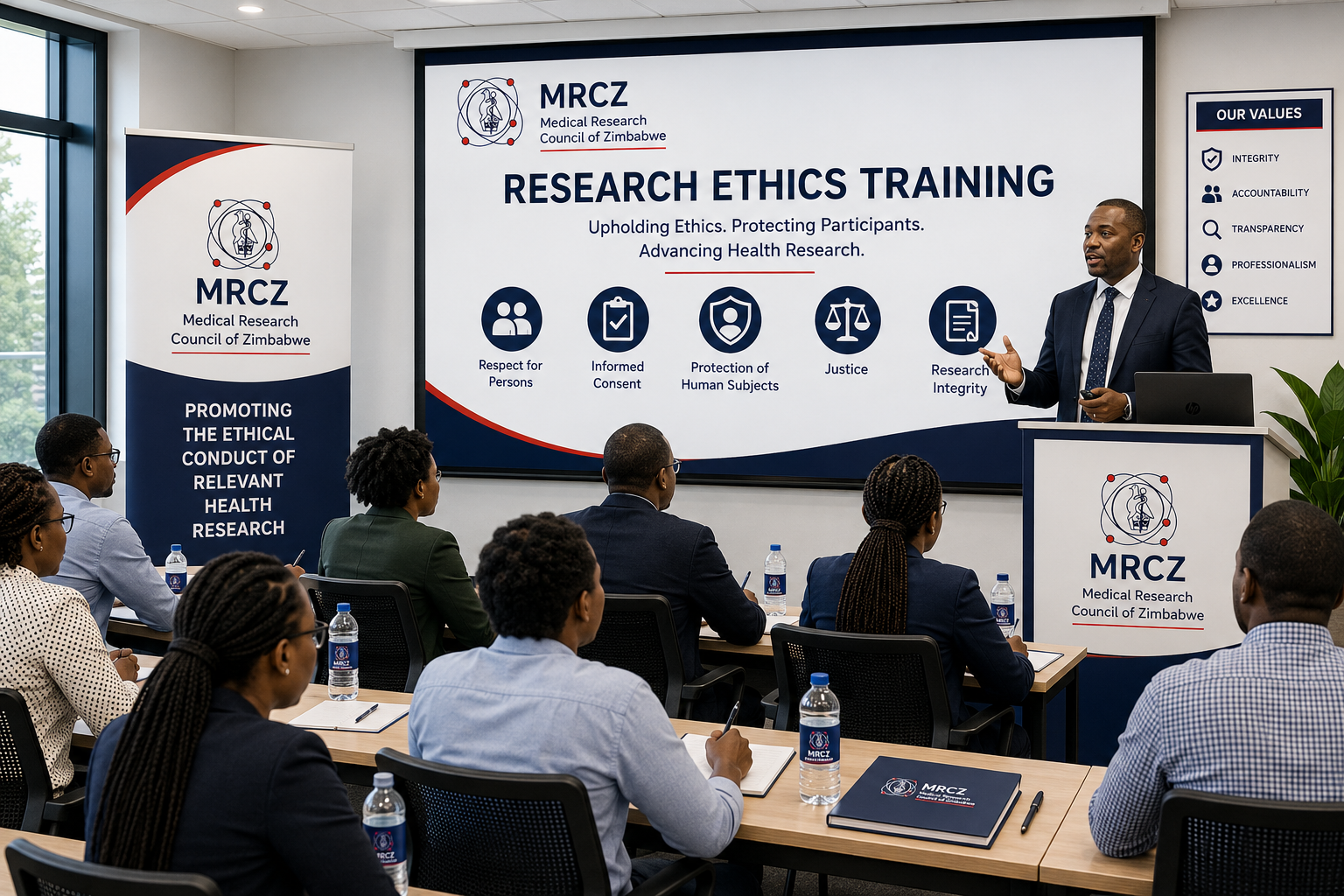
The Medical Research Council of Zimbabwe (MRCZ) offers a comprehensive 3-day training programme on Research Ethics and Good Clinical Practice (GCP), tailored for institutions involved in health and clinical research. The training is designed to build capacity in the ethical and scientific conduct of research involving human participants. The issued certificate is valid for 3 years.
- Duration: 3 days
- Cost: USD 40 per person per day
- Training is conducted upon request
Site Inspection Visits
The Medical Research Council of Zimbabwe (MRCZ) conducts routine and for-cause site inspection visits to ensure that approved research studies are being implemented in compliance with ethical standards, ICH-GCP guidelines, and the approved protocol. These inspections help assist or compliment the protection of research participants, proper data handling, and documentation of serious adverse events.
Site inspections may be routine (pre-identified at the time of protocol approval) or for-cause (triggered by protocol violations, safety concerns, or suspected non-compliance). Researchers are notified in advance, and inspections are carried out by trained MRCZ Secretariat staff, often under the supervision of the Ethics Committee (EC).
During the visit, inspectors review informed consent processes, site facilities, participant records, and compliance with approved documents. Findings are documented in a formal Site Inspection Report and presented at a convened EC meeting. Based on the findings, MRCZ may recommend continuation, modification, or in serious cases, premature termination of the study. A written summary of the outcome is provided to the Principal Investigator within 10 days of the meeting.

IRB Training
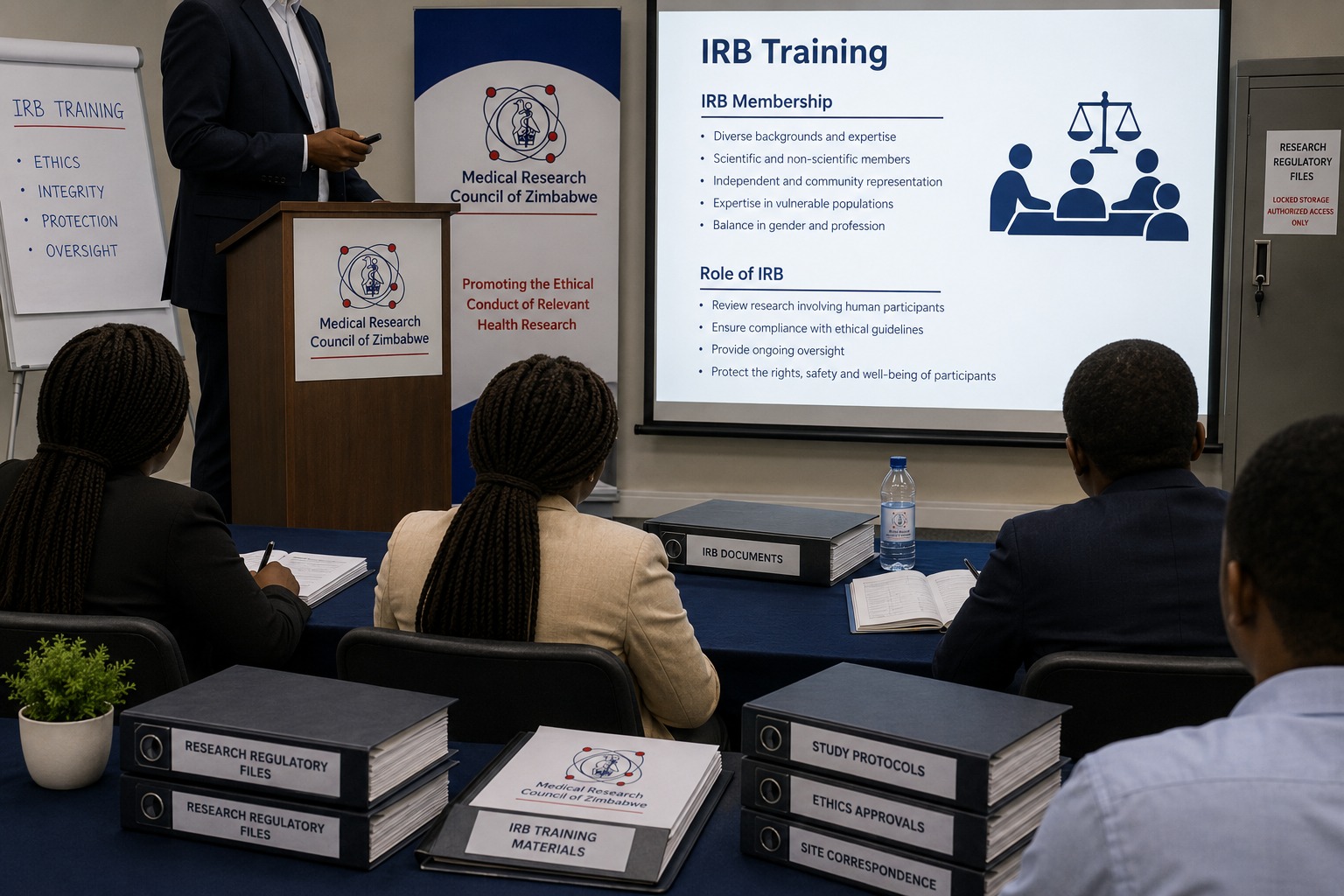
Institutional Review Boards (IRBs) are responsible for reviewing proposed research studies involving human participants to ensure compliance with internationally and locally accepted ethical guidelines. In addition to initial review, IRBs provide ongoing oversight of approved studies and may contribute to the development of institutional research ethics policies.
To ensure that all health research conducted in Zimbabwe is reviewed and monitored according to established standards, the Medical Research Council of Zimbabwe (MRCZ) supports institutions in establishing IRBs. The goal is to develop a strong and robust IRB recognition system that provides effective protection for the health, rights, and welfare of research participants.
Establishing an IRB
Establishing an IRB requires careful consideration of institutional needs and the selection of suitable committee members. Institutions must conduct a comprehensive needs assessment to identify gaps in ethics education, policy development, and oversight capacity.
IRB members should be selected based on relevant knowledge and experience, familiarity with institutional policies, and demonstrated honesty and integrity. The effectiveness of an IRB is strongly influenced by the level of administrative and financial support from the parent institution, as well as by the active involvement and cooperation of senior management.
Institutions are encouraged to request MRCZ training only once they are fully committed, as maintaining a functional IRB requires sustained commitment, teamwork, and institutional support.
Educating IRB Members
MRCZ provides initial IRB training using tailored modules that incorporate Zimbabwean regulatory and contextual examples. Following this training, institutions are required to develop an implementation plan with clear timelines.
Composition of an IRB
An IRB must be properly constituted to ensure thorough, independent, and balanced ethical review. At a minimum, an IRB should:
- Have at least five (5) members with diverse backgrounds
- Include at least one scientist
- Include at least one non-scientist
- Include at least one member not affiliated with the institution
- Include a community representative
- Include expertise relevant to vulnerable populations where applicable
- Not be composed entirely of members of one gender or one profession
The IRB may invite non-voting, ad hoc members to provide subject-matter expertise or guidance on issues related to vulnerable populations.
Principles of a Successful IRB
A functional IRB should be:
- Properly constituted in terms of expertise, gender balance, age, and number
- Independent and free from undue external influence
- Transparent, with clearly documented SOPs
- Consistent in decision-making to promote fairness and equity
- Reliable and trustworthy
Steps to Establishing a Successful IRB
- Secure leadership commitment and institutional support
- Educate institutional staff on the value and role of an IRB
- Select willing and committed IRB members
- Facilitate IRB member training through MRCZ
- Develop guiding principles and SOPs
- Establish a committee charter or legislative authority
- Define and implement IRB operational processes
- Pilot IRB processes and conduct deliberations